Showing posts with label Halloween. Show all posts

Retro Halloween Cat - Free svg


Inspired by the vintage Luhr Halloween Cut Outs - 
this version was cut on my cricut

I used a shiny thick black cardstock (in the packs from Dollar Tree - not certain they still carry them?) And for the yellow and orange I used Bazzil cardstock with raised polka dots.  The extra textures really help the design pop, in my opinion.  :-)


Miss Kate cuttables has a somewhat similar owl, as the Luhr design below, as an svg, for $1.


Vintage Luhr Halloween Cut Outs

Today's Rabbit Trail - Vintage Luhr Halloween Cut Outs, and The Dennison Bogie Book (Games, Recipes, and decor ideas for Halloween Parties)
The vintage Halloween cut outs that I love, and wanted to recreate with my cricut, were made here in Pennsylvania, by the Beistle Company of Shippensburg - still in business today. H.E. Luhrs worked his way up through the firm, becoming president of Beistle in 1941. The company was well known for making very detailed paper die-cuts, lanterns and table items.
There were two premier American die-cut and party supply manufacturers from this era: the Beistle Company of Shippensburg, Pennsylvania and the Dennison Manufacturing Company of Framingham, Massachusetts.


The Dennison Company published an annual "Halloween Bogie Book" from 1909 into the 1930s. Primarily an advertisement for their Halloween decor, the booklets are full of great illustrations, suggested menus, party games, decorating tips, costume ideas and tips for making the costumes.. They are wonderful to browse, and many of them are available in online archives.
In the 1920s, Halloween Parties were for adults, they were not focused on children. They frequently centered around Bridge, Mahjong, and similar game. " Tables and walls would be decorated with a wide array of Halloween-themed items, really setting the party’s mood. The games’ winners would be given prizes to take home, like candy containers, lanterns or noisemakers. Only later did “trick or treating” come into vogue, with the holiday becoming then more firmly oriented toward children. I tend to savor those items made in the interlude before Halloween became so child-focused." Halloweencollector DOT com

Trick or treating is mentioned in some papers as early as 1910 - but it was not common. It became popular and widespread after World War II.
While the adults were playing games, the children were pulling pranks. Halloween in the 1920s was sometimes called "Gate Night" - as so many farm gates were removed from their hinges. Other common Halloween night pranks included tipped outhouses, farm wagons placed on barn roofs, and soaping windows. By 1933, the pranks had escalated, with hundreds of teenage boys sawing down telephone poles & flipping cars.

In the 1920s, to help combat the prank problem, towns began holding Halloween parades, with the communities marching down main street in costumes, to a bonfire, sometimes with free candy distributed.
"Basements Of Terror" (early haunted houses) became popular in the 1930s. A 1937 party pamphlet suggested decorating with old fur strips and raw liver hung on the walls.
During World War II, 1942-1947, sugar was rationed, allowing only half a pound of sugar per a person, per a week. Common Halloween treats were peanuts, coins, fruit, and small toys. In Pittsfield, Massachusetts, children pledged not to vandalize, in support of servicemen abroad
By the late 1940s, towns were holding Halloween Window Painting Contests, with the idea that if the children painted the towns store windows, they would be less likely to soap them.
Dennison published booklets for a variety of holidays and crafts, not just Halloween. In 1948 they published a 37 page booklet (originally published in 1923) titled How to make flowers with Dennison crepe paper. See that book here.


In the facebook post here: https://www.facebook.com/share/p/1525fPHHHZo/
I have links where you can view and even download many of the old Bogie Books. Click on each photo, the links to the books are in the photo descriptions. (Eventually I'll add them to this post, but I'm short on time at the moment)


Where To Find Free Halloween Cards


============
Free SVGS For 
HALLOWEEN CARDS
Find More Free Card Making SVGS Here:
Reminder - I'm an affiliate for several sites, and if you click on the links for FREE SVGS in this post and then make a purchase, I could possibly make a few cents in commission.  As always, this is no way effects the price you pay.
======================
A Haunted House Halloween Candy Box SVG, free from


Haunted House Cascade Card
Free SVG From

Free simple insert card svgs from

Graveyard Card, free svg from


Set of 4 cards, free from

All free From Drizy Studio

Pop up Halloween card - Free svg from


Free svg from

Halloween Cat Box Card, free svg from


Halloween Pop Up Card - free svg from

Halloween House Cascade Card
Free svg from:

Graveyard Gate Card, Free svg from

A Rubberband Pop Up Halloween Card. Free Cut files and instructions from

Free from:


Halloween Slider Card svg


Halloween Step Sides Card svg free from

Free svg from


Free svg from

===================
TEXT
This is the part of the post where I place random text or poems, to help balance out the number of links in the post - so that the posts are not flagged as too link intensive.
====================
The History of Greeting Cards

The history of greeting cards from their early Chinese and Egyptian origins to Europe and the U.S.

The history of greeting cards dates back to the ancient Chinese who exchanged messages of goodwill to celebrate a New Year, and to early Egyptians who used papyrus scrolls to send greetings. Key dates in greeting card history include:

  • 1400’s: Europeans begin selling and exchanging handmade greeting cards, including Valentine’s Day cards (1415)
  • 1775: Members of the Second Continental Congress appoint a Postmaster General for the United Colonies, creating the U.S. Post Office Department (predecessor to the United States Postal Service – USPS) on July 26. The USPS is the second oldest federal department or agency.in the U.S.
  • 1800’s: Valentine’s cards become popular and affordable; the Penny Post debuts. Click here to look at some card samples from that time period. 
  • 1840: Postage stamp is introduced.
  • 1843: First known Christmas card is published in London when Sir Henry Cole hires artist John Calcott Horsley to design a holiday card for his friends.
  • 1849: Esther Howland becomes the first regular publisher of valentines in the U.S. and sells her first handmade Valentine. Howland establishes a successful publishing firm specializing in elaborately decorated cards.
  • 1856: German immigrant Louis Prang opens a small lithographic business near Boston, and America’s greeting card industry begins. The GCA recognizes the Father of the American Christmas Card with its annual LOUIE Awards, the definitive competition of the greeting card and social expression industry.
  • 1866: By this time, Prang perfected the color lithographic process, as shown in his reproductions of famous paintings, surpassing the quality produced by craftsmen in the U.S. and England.
  • 1870s (early): Prang publishes deluxe editions of Christmas cards, sold mainly in England.
  • 1875: Prang introduces the first complete line of Christmas cards in America.
  • 1941: A small group of publishers, under the leadership of George Burkhardt of Burkhardt-Warner, established the Greeting Card Industry, predecessor of today’s Greeting Card Association.
  • 1943: The association cooperated with the Post Office, later to become the United States Postal Service, on the first “Mail Early” Christmas campaign.
==================
Holiday History - From Hallmark
Always celebrated October 31
First Halloween Cards in the US were produced in 1908

Halloween is a secular celebration based on ancient Druid customs, dating back to 700 B.C. The Druids, a Celtic religious order in ancient Britain, Ireland and France, believed that the souls of the dead returned to mingle with the living on “hallowed eve”. People dressed in costumes to disguise themselves from these spirits.

Halloween first was celebrated in the United States in the 1840s, when Irish Catholics, fleeing from the potato famine, brought Halloween customs with them to America. The tradition of carving pumpkins into jack-o’-lanterns originated with Irish children who carved out the centers of rutabagas, turnips and potatoes and placed candles inside.

The first Halloween cards in the U.S. were produced in 1908. Hallmark produced its first Halloween cards in the 1920s along with a limited line of Halloween party accessories, such as nut cups and bridge tallies. In the late 1950s and early 1960s, Hallmark began producing Halloween centerpieces, masks, children’s things and paper partyware items.

========================


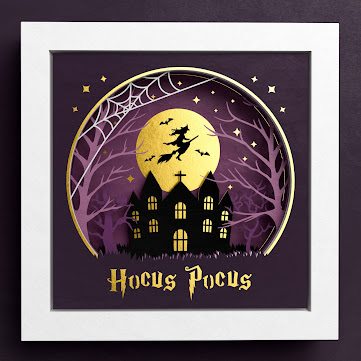
Where To Find Free Halloween Shadow Box SVGS


Where To Find  Free SVGS For Lighted Halloween Shadow Boxes

====================
Reminder - I'm an affiliate for several sites, and if you click on the links for FREE SVGS in this post and then make a purchase, I could possibly make a few cents in commission.  As always, this is no way effects the price you pay.
======================

This was the October 2023 freebie from Nice To Cut.  I keep a list of free this month only designs - and the majority of the list is shadow boxes.  Designers offer them for free for ONE MONTH ONLY.  Check the list each month, here:


Free svg from

Free from

The size on this one is different..  but if you cut the yellow from a yellow vellum and put a light behind it, this could be really cool.  :-)


Not actually a shadow box - but isn't this a neat idea?  Put vinyl on vellum, attach it to your pumpkin..  it's a cheat version of pumpkin carving.  :-) 


Two different trick or treat dioramas


====================
SHADOW POEMS
Text to balance out the link intensiveness of this post
=================
My Shadow
BY ROBERT LOUIS STEVENSON
I have a little shadow that goes in and out with me,
And what can be the use of him is more than I can see.
He is very, very like me from the heels up to the head;
And I see him jump before me, when I jump into my bed.

The funniest thing about him is the way he likes to grow—
Not at all like proper children, which is always very slow;
For he sometimes shoots up taller like an india-rubber ball,
And he sometimes gets so little that there's none of him at all.

He hasn't got a notion of how children ought to play,
And can only make a fool of me in every sort of way.
He stays so close beside me, he's a coward you can see;
I'd think shame to stick to nursie as that shadow sticks to me!

One morning, very early, before the sun was up,
I rose and found the shining dew on every buttercup;
But my lazy little shadow, like an arrant sleepy-head,
Had stayed at home behind me and was fast asleep in bed.

===============
To My Shadow
by Thomas Wentworth Higginson

A mute companion at my side
Paces and plods, the whole day long,
Accepts the measure of my stride,
Yet gives no cheer by word or song.

More close than any doggish friend,
Not ranging far and wide, like him,
He goes where'er my footsteps tend,
Nor shrinks for fear of life or limb.

I do not know when first we met,
But till each day's bright hours are done
This grave and speechless silhouette
Keeps me betwixt him and the sun.

They say he knew me when a child;
Born with my birth, he dies with me;
Not once from his long task beguiled,
Though sin or shame bid others flee.

What if, when all this world of men
Shall melt and fade and pass away,
This deathless sprite should rise again
And be himself my Judgment Day?


=================
Shadows
By Thomas Durfee
How much of earth’s beauty is due to its shadows!
The tree and the cliff and the far-floating cloudlet,
The uniform light intercepting and crossing,
Give manifold color and change to the landscape.
How much, too, our life is in debt to its shadows;
To griefs that refine us and cares that develope,
And wants that keep friendship and love from decaying;
With nothing to cross us we perish of ennui.
=====================


I saw a young mother
With eyes full of laughter
And two little shadows
Came following after.

Wherever she moved,
They were always right there
Holding onto her skirts, 
Hanging onto her chair.
Before her, behind her—
An adhesive pair.

“Don’t you ever get weary
As, day after day, 
your two little tagalongs
Get in your way?”

She smiled as she shook
Her pretty young head, 
And I’ll always remember
The words that she said.

“It’s good to have shadows
That run when you run, 
That laugh when you’re happy
And hum when you hum—
For you only have shadows

When your life’s filled with sun.”